
DIY Visa Applications versus RMA-Managed Visa Applications - The Facts

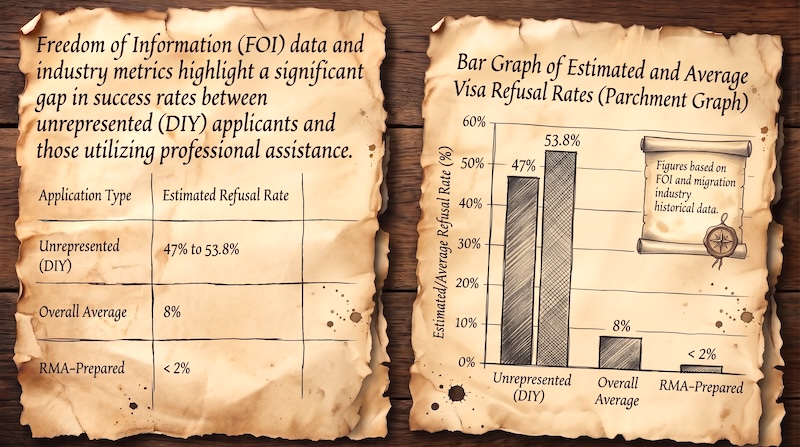
Freedom of Information (FOI) data and industry metrics highlight a significant gap in success rates between unrepresented (DIY) applicants and those utilizing professional assistance.
|
Application Type |
Estimated Refusal Rate |
Source Context |
|
Unrepresented (DIY) |
47% to 53.8% |
Historical FOI data explicitly tracking applications submitted without a migration professional revealed that approximately half of all DIY partner visas were refused. |
|
Overall Average |
8% |
Recent FOI data (January 2023 – February 2024) for all Subclass 309/100 offshore partner visas combined. |
|
RMA-Prepared |
< 2% |
While the Department of Home Affairs does not officially publish an isolated "agent-only" refusal percentage, established migration firms routinely report success rates of 98% or higher due to rigorous document checking. |
Question: Is it better to use a Registered Migration Agent or apply for an Australian Partner visa myself?
Answer: You can apply for an Australian Partner visa yourself, but you are responsible for ensuring that your application meets the requirements and that your evidence supports your relationship claims. Down Under Visa's key message is that a genuine relationship alone is not enough: the application must clearly demonstrate the relationship through consistent, relevant evidence across the financial, household, social, and commitment aspects.
A Registered Migration Agent can provide tailored advice, identify evidence gaps, cross-check documents, and help address complex migration requirements before lodgement. DIY applicants can reduce avoidable mistakes by carefully checking eligibility, ensuring all information is consistent, and responding properly to any request from the Department of Home Affairs.
The real difference is not who fills in the form—it is whether the application tells a complete, consistent, evidence-backed story. Professional assistance may help identify risks, but no agent can guarantee a visa grant.
Why DIY Applications Fail at Higher Rates
The stark difference in refusal rates typically comes down to strict legal and evidentiary requirements that unrepresented applicants overlook:
- Insufficient Evidence Across the Four Pillars: A common misconception among DIY applicants is that a marriage certificate or de facto relationship registration is enough to prove a genuine relationship. Unrepresented applicants frequently fail to provide comprehensive evidence across all four mandatory assessment pillars: financial, social, household, and mutual commitment.
- Inconsistent Documentation: DIY applicants often submit statutory declarations with dates and timelines that contradict their official documents (such as lease agreements or bank statements). Case Officers are trained to look for these discrepancies, viewing them as immediate red flags.
-
Legislative Misunderstandings: Unrepresented applicants frequently fail to understand complex public interest criteria, such as character or health requirements, or they miss the strict 28-day window to appropriately answer a Case Officer's Request for Information.
The Devastating Hidden Costs of a Refused DIY Application
When you look at the 47% to 53.8% refusal rate for DIY applications, it’s easy to view it as just a dry statistic. But behind those numbers are separated couples, broken dreams, and completely drained bank accounts. The Department of Home Affairs is unforgiving, and they certainly do not offer refunds for visa refusals. With partner visa application charges currently sitting at nearly $12,000 AUD—and that’s before you even factor in the costs of mandatory medical exams, police clearances, biometrics, and document translations when needed—a DIY failure is a financially devastating mistake.
If your unrepresented application is refused, your options are incredibly grim. You either have to start entirely from scratch, paying those massive government application fees all over again, or you must take your case to the Administrative Review Tribunal (ART) for a merits review appeal. An ART appeal adds thousands of additional dollars in tribunal fees and professional representation costs. Worse still, it plunges you into a massive waiting queue that can take literally years to clear (usually 3 1/2 years!). During this incredibly stressful time, your life and your relationship are effectively put on hold, often while you are separated by thousands of kilometers.
The "Facebook Expert" Trap: Why One Size Does Not Fit All
One of the primary reasons unrepresented applicants fall into that high refusal bracket is their heavy reliance on social media advice. It’s highly tempting to join a free Facebook group and follow the guidance of someone who successfully lodged their own partner visa. But as we often remind our clients, just because "Steve and Maribeth" got their visa approved doesn't mean their amateur strategy will work for you.
Australian migration law is highly complex, rigid, and constantly evolving. What worked perfectly well for someone else in 2021 might trigger an automatic refusal or Request for Information (RFI) today. Furthermore, no two relationships are ever identical. A couple who recently met online and have spent only a few weeks together in person will require a vastly different evidentiary strategy than a couple who have been living together in a de facto relationship for five years. Relying on a stranger's generic checklist usually results in submitting irrelevant documents while completely missing the critical evidence your specific case desperately requires.
The Subjectivity Factor: How Case Officers Actually Make Decisions
Another crucial element DIY applicants completely miss is the human factor. Case Officers are strictly directed by migration legislation, but they also apply internal policy guidelines to assess the overall "genuineness" of your relationship. They are looking for a clear, compelling narrative that seamlessly connects the dots across your financial, social, and household evidence.
When you manage your own application, you are deeply emotionally invested. You know your love is real, so you assume the Case Officer will just intuitively "get it." You might submit a thousand WhatsApp messages and fifty identical selfies, thinking sheer volume proves your mutual commitment. But to an overworked Case Officer, this is just frustrating clutter. A Registered Migration Agent strips away the emotion and looks at your application through the highly critical, objective lens of the Department. We know exactly what Case Officers want to see, how they prefer it presented, and—most importantly—what immediately raises red flags.
What an RMA Actually Does (Beyond Filling Out Forms)
Many people mistakenly believe an RMA just fills out the online IMMI Account forms for you. In reality, data entry is the absolute smallest part of the job. A good RMA acts as your project manager, your legal advocate, and a ruthless auditor of your life together. We cross-reference every single document, statutory declaration, and piece of evidence before it goes anywhere near the Department of Home Affairs. We spot the contradictory timeline dates, the suspiciously weak financial links, and the subtle character or health concerns that you might not even realize are highly problematic.
By having a professional manage your application, you aren't just paying for paperwork—you are investing in your future peace of mind, maximizing your chances of falling into that < 2% refusal bracket, and ensuring your life together in Australia starts as soon as humanly possible.